Period Property Specialists · Est. 1997
Dark, painted and water-stained beams brought back to life — in an occupied home, by hand, and without a single day of blasting or dust.
1,000+ properties restored No sanding, no blasting, no dust
01 — What you get
No blasting, no grinding, no residue. No sheeting, no clear-out, and nothing to clean up after we leave.
We build a finish up in fine coats rather than stripping one away. Grain, tool marks and the joiner's own markings stay exactly where they are.
Every application is water-based and virtually odourless. No corrosive chemicals, no solvents, no aerosols — safe around children and pets.
02 — Day one
Before lunch on the first day, one beam is finished. Not a swatch — a beam, in your room, in your own light.
We ask that you're both there to see it, because it's easier to agree in front of the thing than over a photograph. Nothing else is touched until you tell us it's right.
Three coats, sometimes more, each fine enough that the first is dry by the time we've worked round the room. The second goes on before lunch — which is why you're looking at a finished beam on day one.

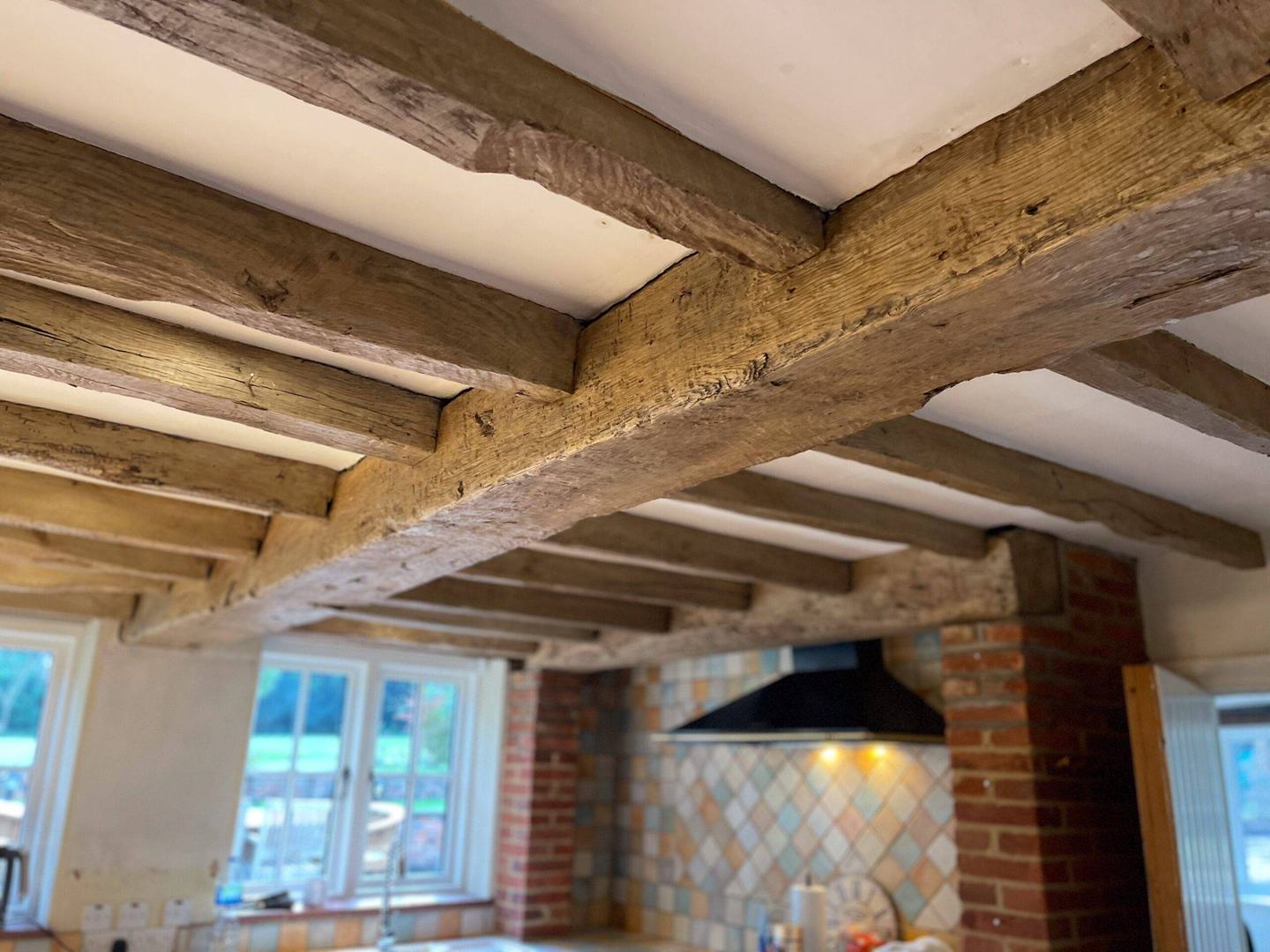
 BeforeAfter
Drag to compare. Same beams, same room, same light.
03 — The same timber, twice
It was concealed. It was never lost.
Black paint brings a uniformity that sits at odds with old timber. Grain, tonal variation and the individual marks of the person who cut it all flatten out. The surface reads as consistent — and almost everything that made it distinctive stops being visible.
04 — The process
The method was developed by Penny Sinclair, working on period properties in 1997. Faced with beams that would ordinarily have been stripped or blasted, she chose not to. Instead she worked the surface by hand — an approach that brought the timber back into balance without taking anything away.
That became the process. It has been refined through continuous work ever since, and is now carried forward by the second generation.
A controlled application brightens tone and brings the grain forward.
No replastering, no redecorating, no preparation beforehand.
We confirm the timeline at assessment, before anything begins.
Every surface detail remains intact.
Nothing is stripped, so there is nothing to clear up.
No corrosive chemicals or solvents.
Each property worked personally, not scheduled around.
05 — Signature finishes
Chosen for the tone and age of your property, not imposed on it.


06 — Water damage
Water damage doesn't blacken a beam evenly. A leak or an old flood leaves it patchy, streaked, lighter in places than the timber around it — and the usual answers are to blast it or to bleach it, because both even the beam out by taking something off it.
We don't do either. Before anything touches the surface, the first question is whether the timber is sound: dried out, no ongoing damp, nothing soft or crumbling. That's a structural judgement and we'll tell you plainly if the answer is no.
If it's sound, uneven staining is a finish problem. We even it out from above, in fine coats, by hand. Nothing blasted, nothing bleached, nothing sanded, and no sound wood removed to chase a mark out.
A beam that has been under water is the hardest thing we are asked to do. If that can be evened out by hand, a painted one is straightforward.
07 — The craftsman
The method has been refined within the family ever since. The hands-on work is now carried out by Peter, trained directly in it. Nick oversees each commission personally.
Back From Black was invited three times onto George Clarke's Old House New Home.
Never missed a job. Always on time. Over decades, and thousands of miles of UK roads.
08 — Common concerns
One beam is finished before lunch on the first day, in your room and your own light, and nothing else is touched until you say it's right.
The process works across multiple coats and varying condition without removing the material beneath.
No replastering, no redecorating, no making good afterwards. The walls, ceilings and paintwork around the beams are left untouched.
Designed for occupied homes. Water-based and virtually odourless throughout.
Water damage is patchy rather than evenly dark, and blasting or bleaching even it out by taking material off the beam. Once we've confirmed the timber is sound, we do the opposite: even it out from above, in fine coats, and take nothing away.
Tell us where the property is and we will confirm. In most cases we can reach you.
09 — The honest answer
People ask whether this is simply painting the beams a different colour. It is a fair question, and worth answering plainly: a finish is applied. We have never claimed otherwise.
What matters is what happens underneath. The conventional route to lighter beams is removal — blasting, grinding, or chemical stripping. All of them take the surface away with the paint. Tool marks, hand-shaping, the shallow irregularities left by whoever cut the timber four centuries ago: once those are gone, nobody can put them back.
Our method works on the surface rather than through it. Tone is brightened, grain and markings come forward, and the record of the building stays exactly where it is.
Removes the paint and the surface with it. Detail lost is lost permanently.
Three fine coats, applied by hand. Nothing removed.
So the choice is not paint or bare oak. It is a finish that sits on the timber, or a process that removes part of it for good.
And if stripped, raw timber is what you actually want — we are not the right people, and we will say so. The methods that get you there will cost you the surface.
10 — The offer
No site visit. We will tell you plainly whether your beams suit the process.
Thirty years of calibration means we know the finish you're after from the way you describe it. You don't need the right words — send a photo.
Send three photographs of the beams — one wide, two close. We will come back with which of the three finishes suits the timber, what the room would take, and whether we think it is worth doing at all.
Including when it isn't.
Why we ask you to go first. We take few projects at a time, because each one is worked personally rather than scheduled around. The assessment tells us whether your property is one we can do properly — and tells you before you have spent anything.
No cost. No obligation. No site visit. If your beams are not suitable we will say so.
Received
She will be in touch within one working day. If you would like to send your three photographs now, WhatsApp is quickest.